
Aviation and maritime transport remain among the most challenging sectors to decarbonise, together accounting for approximately 2.5 % of global CO₂ emissions and facing limited scalable low-carbon alternatives.
This is where Sterope comes in. By transforming industrial CO₂ emissions into advanced renewable fuels for aviation and maritime transport, Sterope is developing an integrated, scalable and replicable pathway to support the defossilisation of these hard-to-abate sectors while reinforcing Europe’s climate, energy and industrial ambitions.
Supporting Europe’s transition to sustainable fuels
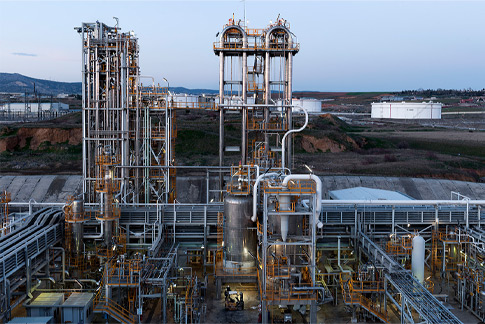
Sterope directly contributes to the deployment of sustainable fuels required under key European policy frameworks, including ReFuelEU Aviation and FuelEU Maritime. The project’s approach combines carbon capture and utilisation (CCU) technologies, renewable hydrogen and refinery-scale integration to produce enewable drop-in fuels compatible with existing infrastructures and aligned with real market deployment conditions. Sterope aims to accelerate the uptake of low-carbon fuels for aviation and shipping while strengthening Europe’s energy resilience and reducing dependence on fossil carbon.
Significant climate mitigation potential
STEROPE demonstrates strong climate mitigation potential. Assuming only 1 % penetration of the EU aviation and maritime fuel market. Sterope-type solutions could avoid more than 3.5 million tonnes of CO₂ emissions per year. This highlights the strategic role that CCU-based fuels can play alongside electrification, renewable energy deployment and other decarbonisation pathways needed to achieve climate neutrality.
Turning CO₂ emissions into industrial opportunities
Beyond climate benefits, Sterope demonstrates how industrial emissions can become a valuable resource. By converting captured CO₂ into high-value renewable fuels, the project creates opportunities for industrial emitters to:
- unlock new revenue streams through CO₂ utilisation;
- reduce exposure to rising carbon costs;
- adopt circular economy and industrial symbiosis approaches within existing industrial ecosystems.
In this way, STEROPE contributes not only to emissions reduction but also to building more resilient, competitive and circular industrial value chains.
Towards long-term economic and technological impact
Looking ahead, widespread deployment of Sterope-type solutions by 2040 could generate substantial economic benefits, including up to 95 % reductions in CO₂-related costs and around €3 billion annually through fuel sales, technology licensing and carbon credit mechanisms.
At the same time, Sterope is expected to generate valuable technical, environmental and economic evidence to support future EU policymaking, investment decisions and research and innovation actions in the field of CCU and sustainable fuels. By validating an integrated e-SAF and e-methanol production system under real refinery conditions, the project will help raise the technology readiness level of these solutions, accelerating their pathway towards commercial deployment.
Through collaboration between major industrial players, technology developers and research organisations, STEROPE is reinforcing Europe’s leadership in sustainable fuel innovation across the energy, refining, aviation and maritime value chains.